
Wholesale Real Estate Leads: How To Find Them Free
Aug 04, 2026

Written by
Alex Martinez — Founder & CEO, Real Estate Skills. Has wholesaled and flipped houses for over a decade, personally acquiring 33+ residential investment properties.
Reviewed by
Ryan Zomorodi — Co-Founder & COO, Real Estate Skills. Verified the lead sourcing methods, state law citations, and deal figures in this guide before publication.
Publication history: Originally published September 1, 2022. Updated August 2026 with corrected state wholesaling law citations, on-market filtering strategies, off-market public records methods, current lead cost data, and deal qualifying guidance. State statutes and lead sourcing methods verified by Ryan Zomorodi, Co-Founder & COO of Real Estate Skills.
Wholesale real estate leads are property owners who need to sell fast enough that speed matters more to them than price. You find them two ways: on-market, by filtering listing sites for distress signals, or off-market, through public records like foreclosure filings and code violations. Most cost nothing but time.
Most people looking for wholesale leads are looking in the wrong place — and paying for the privilege.
The standard advice is to buy a list. Absentee owners, high equity, pre-foreclosure. So you buy it, and so does everyone else in your market, and now you're the fourth postcard that homeowner got this month. That's not a lead. That's a mailing address someone sold you.
The leads worth having are the ones you find yourself, and most of them are hiding in plain sight. A price cut on a listing that's been sitting 90 days. A foreclosure notice that became public record two weeks ago. A code violation lien recorded against a title. All of it is free to find. Almost none of it is what beginners are told to chase.
This guide covers both halves — the on-market filters that surface distressed listings in about a minute, and the off-market records that put you in front of an owner before anyone else knows they need to sell. Ryan Zomorodi walks through the live version of both in the videos below, and broker Henish Pulickal, who ran a lender's REO department during the 2007–2009 crisis, explains what's actually happening on the other side of a distressed sale. Before you work a new market, download our free state-by-state legal guide to check the rules where you're operating.
How To Find FREE Wholesale Real Estate Deals!
Alex Martinez shows you how to find distressed properties and motivated sellers using on-market data — no direct mail, bandit signs, or paid ads required.

How To Find Wholesale Leads On The Market (For Free)
On-market leads are distressed properties already listed for sale. You find them by filtering listing sites for price cuts, long days on market, low price per square foot, and fixer-upper language. It costs nothing, takes about a minute, and most wholesalers ignore it entirely.
Here's the argument for starting here, and it's a number rather than an opinion.
According to the National Association of Realtors' 2025 Profile of Home Buyers and Sellers, 91% of sellers used a real estate agent — a record high — while just 5% sold their homes themselves, an all-time low. So while most wholesaling advice sends you chasing the small slice of owners selling without an agent, nine out of ten sellers are standing somewhere public, represented, and reachable.
The objection is obvious: if it's listed, everyone can see it, so where's the discount? The answer is that being listed isn't the same as being wanted. A house with no flooring, a cracked slab, and forty-year-old bathrooms cannot get conventional financing. Retail buyers can't touch it. The pool of people who can actually buy that property is small, and it's the pool your cash buyers swim in.
The other objection is access. The MLS — the Multiple Listing Service, the database agents use to list properties — requires a license. Most beginners don't have one. You don't need it. Agents list on the MLS and then syndicate to public sites, so the same inventory shows up on Redfin, Zillow, and Realtor.com within hours. Not every field carries over, and the data is thinner. It's enough. If you do want the full picture, here's getting MLS access explained.
Six Filters That Surface Distressed Listings
Six filters do the work: price per square foot, price reductions, days on market, fixer-upper flags, keyword searches, and low absolute price. Each one surfaces a different kind of motivation, and stacking two of them narrows a market of thousands to a list you can call in an afternoon.
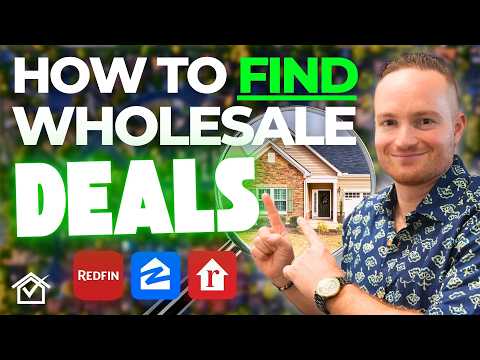
Ryan runs these on Redfin, but the same filters exist on most listing sites. Before you start, switch out of the default photo-and-map view into the table view — you'll see every property's stats side by side instead of scrolling through pictures one at a time. That change alone is most of the speed.
How To Find Wholesale Real Estate Deals (FAST & FREE)!
Ryan Zomorodi demonstrates all six filtering strategies live, then analyzes a real property to determine a wholesale offer price.
1. Price Per Square Foot, Sorted Lowest First
Take the asking price, divide by the home's square footage. It's the fastest proxy for value there is, because it strips out size and lets you compare a small house to a big one honestly. Sort ascending and the cheapest square footage in the market floats to the top. Some listings won't have a figure because no square footage was entered — those aren't necessarily bad, just unsorted.
2. Price Reductions
A seller who cuts their price has already told you something changed. Most sites let you filter by how recently — last day, last three days, last month. A property that dropped $10,000 last week is a different conversation than one that's held firm since listing.
3. Days On Market
Sites label it differently — Redfin calls it Time on Redfin — but it means the same thing. Past ninety days, the property isn't selling, which almost always means the price is wrong. Nobody has made an offer the seller will take. That's an opening.
Worth knowing why so many of these exist: agents sometimes win listings by promising a price the market won't pay. The seller signs, nothing happens, and the reductions start. Those stale listings and price cuts are the residue of that, and there are more of them than you'd think.
4. The Fixer-Upper Filter
Redfin runs an algorithm that flags listings it reads as needing work, based on the photos and the agent's own wording. It won't catch everything, and in a small market it may return almost nothing. In a large one it's the fastest cut to the most distressed properties available.
5. Keyword Search
Type what an agent writes when they're quietly advertising to investors: as-is, fixer, TLC, handyman special, investor special, motivated, cash, flip, contractor, value-add. Each term returns a different set. Search "motivated" and you'll find listings that say motivated seller, bring all offers — which is an agent telling you the price is negotiable before you've said a word.
6. Straight Price, Lowest First
Crude, and it surfaces some junk. It also surfaces the cheapest houses in the market, and there's usually a reason they're cheap.
📓 From The Field
Then stack them. Filter for fixer-uppers and price-reduced in the last thirty days and a market of two thousand listings becomes a handful. That's the whole technique — not one clever filter, but two ordinary ones crossed. When you've got a set that works, save the search. Most sites will email you new matches daily, which turns a one-time exercise into a standing pipeline that runs without you.
Reading Motivation In A Listing
The filters find candidates. The listing itself tells you which ones are urgent. Price history, agent wording, and terms like "as-is, no repairs" reveal how much room a seller actually has — before you make a single call.
Three things to read on every listing, in order.
The price history. Not the current price — the whole sequence. Ryan walked one that had been listed at $200,000, cut several times, pulled off the market, relisted at $159,000, gone under contract, and fallen out of escrow when the buyer's financing failed. It had been sitting for months since. Every one of those events is pressure. A seller who has already lost one buyer is a seller who wants this over.
The agent's own words. Agents write for the buyer they expect. "Handyman special." "Strong potential for a fix and flip." "Buyers must complete all inspections before submitting an offer" — that last one means they want a non-contingent offer, which usually means the property has problems they'd rather you accept up front. When an agent describes a property as an investment, they've told you who they think will buy it. Be that person.
The photos, honestly. Missing flooring, cracked tile, forty-year-old cabinets, debris left in the frame because nobody bothered to stage it. Ryan's read on one Knoxville listing was simple: no conventional buyer is financing this. That's the signal. A property a retail buyer can't purchase is a property your cash buyer can. Confirm what it's worth by running comps on recent nearby sales.
Then there's the anti-target, which matters as much as the target. A beautiful, updated, correctly-priced house is not a lead. There's no discount available and no reason for the seller to take one. Alex is blunt about it — you can chase those, and you'll waste your time. Not every listing is an opportunity, and the discipline to skip most of them is what makes an hour of this productive.
How To Find Off-Market Wholesale Leads In Public Records
Off-market leads come from public filings — foreclosure notices, code violations, probate cases, tax delinquency. The advantage is timing: you reach an owner before the property is listed and before other buyers know it exists. The catch is that nothing is public until a specific legal event triggers it.
This is where the real discounts are, and the reason is simple. On-market, you're one of several offers. Off-market, you're often the only conversation happening.
But there's a mechanic underneath this that almost nobody explains, and it determines everything about your timing.
The sections below explain how these processes generally work and are educational, not legal advice. Foreclosure, probate, and lien procedures vary significantly by state — confirm the rules in your market with a licensed real estate attorney before acting on any of this.
5 Types of DISTRESSED Sellers & How To Find Them!
Ryan Zomorodi sits down with broker Henish Pulickal — who ran a lender's REO department during the 2007–2009 crisis — to break down each type of distressed seller and how investors find them.

Pre-Foreclosure: The 120-Day Clock
Under federal law, a mortgage servicer generally can't start foreclosure until a borrower is more than 120 days delinquent — usually four missed payments. That first filing is what makes the situation public. Before it, there's no record to find, no matter what tool you're using.
Federal rules prohibit a servicer from making the first notice or filing in a foreclosure unless the loan is more than 120 days delinquent — what the Consumer Financial Protection Bureau calls the pre-foreclosure review period. It applies to loans on a borrower's principal residence, with some exceptions.
Understand what that means for you. A homeowner can miss January, February, and March and be in serious trouble, and you cannot find them. There is no list. The delinquency is between them and their servicer. Only when the servicer files does the situation enter public record — and that's the moment every investor watching those filings sees it at once.
What happens next depends on your state. In California, which uses a non-judicial process, a Notice of Default (NOD) gets recorded publicly, and the homeowner is served or posted with it. Roughly thirty days later, if nothing has been resolved, a Notice of Trustee Sale (NTS) follows, which sets an actual auction date typically twenty-one to thirty days out. Judicial-foreclosure states run through the courts instead and move on different timelines. Your state's process is the one that matters — look it up before you build a strategy around someone else's.
Now the distinction that trips up nearly everyone new. Pre-foreclosure, auction, and REO are not the same thing, and which one you're looking at changes who you're negotiating with:
- Pre-foreclosure — the homeowner still owns it and still decides. You're talking to a person.
- Auction — it sells on the courthouse steps, usually sight unseen, cash only, with whatever liens and occupants come attached.
- REO — nobody bid enough, so the lender owns it. Now it's a bank, an asset manager, and a listing agent, and their job is to recover as much as possible.
📓 From The Field
Henish Pulickal, a California broker who ran a lender's REO department during the 2007–2009 crisis, puts it plainly: with a pre-foreclosure you're working directly with the owner, and they can still decide what happens. Once it's REO, you're behind a middleman whose incentive is to push the price up and manufacture competing offers. Fewer layers, better deal — and better for the seller too, since a completed foreclosure blocks them from buying anything for years, while bad credit alone can be repaired in two or three. Asked which list he'd keep if he could only have one, after two decades in the business, his answer was pre-foreclosure: NOD and NTS filings, and the closer to the sale date, the more urgent the conversation.
Short Sales, And Why They Take So Long
A short sale is when the loans against a property exceed what it's worth, so the lender has to approve taking a loss. That approval is why short sales crawl — someone at the bank has to sign off on writing off the difference, and the bigger the loss, the higher it goes.
If a house is worth $700,000 in its current condition and the owner owes $650,000, that looks like equity — until you add missed payments, penalties, commissions, and closing costs. Suddenly the lender nets less than they're owed. That shortfall is the short sale.
📓 From The Field
Henish worked the other side of these. Running a lender's REO department from 2007 to 2009, he had authority to write off losses up to $150,000 himself; anything larger went to the director of operations. On one file, a $450,000 loan sold for $300,000 and he signed off on the $150,000 write-off. That's the whole explanation for the timeline. It isn't bureaucracy for its own sake — it's a person building a net sheet, cross-checking two independent broker price opinions to confirm the value is honest, and then asking someone senior to approve a loss. When the two valuations disagree badly, everything stops while they figure out why.
Two practical things. A relocation payment for the seller — often $3,000 to $5,000 to move out promptly — is frequently negotiable as part of the deal. And a fully off-market short sale is rare: lenders typically require the property to be exposed to the market for seven to ten days so they can demonstrate they sought the best price. Plan for it rather than being surprised by it.
Code Violations And Recorded Liens
Code violations create forced sellers — a city can lien a property and eventually compel a sale. These leads aren't on the MLS. The fastest route is asking a title officer to search an area for recorded code-compliance liens.
When a property becomes overgrown, unsafe, or uninhabitable, code enforcement gets involved. If nothing changes, the city can clean it up, bill the owner, and record a lien. Enough of those and the city can force a sale.
Finding them takes a workaround. Some cities publish violations on their websites; coverage is inconsistent. The better approach — and this is a genuinely uncommon tactic — is to ask a title officer to run a search across a few zip codes for recorded code-compliance liens. Serious violations get recorded against title. Minor ones don't. That filter is doing real work for you: it separates the properties with actual pressure from the ones with a tall lawn.
Why it matters is mechanical. A recorded lien has to be cleared before the property can transfer, so the seller can't close without dealing with it. That's leverage that exists whether or not anyone brings it up.
📓 From The Field
Henish bought one of these — a house in Mount Soledad so overgrown his project manager couldn't reach the backyard without a machete, which he'd assumed was a joke. It took six dumpsters just to clear the vegetation. Trees had grown through the house and through the pool. Water damage had cracked structural beams. The city was moving to foreclose on the code liens when family stepped in and sold. He paid $1.1 million, put roughly $400,000 into it, and it sold for about $2 million. Individual results vary; this is one deal in one market, not a typical outcome.
Probate, And Why It Usually Doesn't Work
Probate properties are often dated and sometimes cheap, but they're harder than they look. Court oversight, mandatory appraisals, and multiple heirs limit how low a price can go — and in California, a court-confirmed probate sale generally can't close below 90% of the appraised value.
Probate is the court process for transferring property when someone dies without it held in a trust. It involves an attorney, a court-appointed appraiser, notice to every possible heir, and often a long timeline.
Every wholesaling guide lists probate as a top lead source. Here's the counter-argument from someone who's actually bought them: Henish has done several and broken even on a couple. The problems are structural. Under California Probate Code § 10309, a court-confirmed sale must be at least 90% of the appraised value, with the appraisal made within a year of the confirmation hearing — and appraisers sometimes come in high. Worth noting the limit on that rule: many California probates run under full authority through the Independent Administration of Estates Act, where the representative can accept a market-value offer and close without a court hearing. The 90% floor applies to court-confirmed sales.
Multiple heirs make it worse. Henish described a Point Loma listing with fifteen beneficiaries, every one convinced the house was worth more, several of them living nowhere near the market.
The opportunity is real but narrower than advertised: houses that were maintained but never updated, because the owner remodeled at forty and passed at eighty-five. Dated, not distressed. That can work — if the numbers work, which on probate they often don't.
Worth reading that as a general lesson. A lead source being popular is not evidence that it's productive.
Absentee Owners — And Why The List Alone Is Useless
An absentee owner doesn't live at the property — found by comparing the tax mailing address to the property address. On its own that means almost nothing. It becomes a lead only when layered with actual distress signals.
This is the most oversold list in wholesaling. Every data platform sells it, every beginner buys it, and most of the results are landlords who are perfectly happy.
What absentee ownership actually tells you is narrow: this person isn't emotionally attached to the house. That's a starting condition, not motivation.
It becomes a lead when you stack it — with high equity, a prior foreclosure filing, tax liens, judgments, or twenty-five-plus years of ownership, which means the depreciation schedule is exhausted and holding has gotten less attractive. Cross two or three of those and you have a short list of people with an actual reason to consider selling. Our guide on which distressed seller lists convert goes deeper on stacking.
📓 From The Field
An absentee owner sometimes doesn't know what they have. Henish tracked down the heir to a San Diego property by skip tracing relatives across the country until one called back, annoyed that her family was being contacted. She'd been told there was no money in it. His opening was a question rather than a pitch — would it be worth half an hour of your time to find out? She agreed, and he got her $5,000 out of a property she'd written off as worthless.
That's the tone that works on these calls. Not "I want to buy your house." Something closer to there may be money here you don't know about, and it costs you thirty minutes to find out.
Other Ways To Find Wholesale Leads
Beyond listing sites and public records, wholesale leads come from networking, driving for dollars, contractor referrals, auctions, and paid marketing. Each works. None replaces having one channel you run consistently — most beginners fail by sampling all of them shallowly.
The mistake isn't picking the wrong channel. It's running six of them badly. Pick one, run it for ninety days, and learn what your numbers look like before adding a second.
Driving For Dollars
You drive target neighborhoods logging properties that look neglected — blue tarps, boarded windows, overgrowth, stacked mail, code-violation stickers. The advantage is that nobody else has this list, because you made it. It's the only channel where you're guaranteed not to be the fourth postcard. The cost is hours, and the follow-up is where most people quit. Apps built for logging properties as you drive handle the list-building and skip tracing from the driver's seat.
Read Also: Driving For Dollars: The Complete Guide
Networking And REIA Meetings
Local real estate investor association meetings are worth attending, but not for the reason beginners think. Don't go to pitch deals. Go to find out what the active cash buyers are actually buying — price range, neighborhoods, condition. Then go find that. Working backward from a known buyer is faster than finding a deal and hunting for someone to take it. The same rooms are where you start finding cash buyers.
Agents are worth cultivating here too. High-volume agents sometimes hold pocket listings for buyers they trust — properties never syndicated publicly. They won't bring you those until you've demonstrated you can actually close.
Contractors
Plumbers, roofers, and general contractors see distress before anyone else — they're standing in the house when the homeowner learns the repair costs more than they have. That's the moment a property becomes a lead. Cold-emailing tradespeople doesn't work; the exchange has to be real. You send their business to your cash buyers, who always need reliable labor. They call you when a quote goes sideways.
Auctions
Courthouse auctions are cash-only, usually sight unseen, and you inherit whatever liens and occupants come with the property. Online platforms are easier to access and more competitive. Both are real channels, and neither is a beginner channel. There's a reason experienced investors work pre-foreclosure instead — you'd rather talk to the owner before the auction than bid against professionals on the steps.
HUD And Government REO
When an FHA-insured loan forecloses, HUD sells the property through its own portal. Listings include condition reports and disclosures. Owner-occupants get an exclusive bidding window first; investors bid after. Transparent, and worth watching — but inventory is thin in most markets.
Read Also: Wholesaling HUD Homes: How It Works
Craigslist And Facebook Marketplace
Free, which means saturated. The usable move is filtering for-sale-by-owner listings for the same keyword triggers you'd use on Redfin, and posting your own buying criteria to catch landlords quietly exiting. Verify ownership in county records before you negotiate — these platforms are full of people marketing contracts they don't control.
Paid Ads And Lead Capture
Search ads reach people actively looking to sell, which is why they cost what they do. Social ads reach far more people with far less intent, and housing advertising rules limit how narrowly you can target. Either way you need somewhere to send the click and a way to respond fast. Our guide to paid search for motivated sellers covers the setup.
Bandit Signs
Cheap, effective in some markets, and often illegal. Many cities prohibit signs on utility poles and public right-of-ways and fine you for it. Check your local ordinance before you spend a Saturday staking them. Our bandit signs guide covers placement and compliance.
Wholesaling Software
Once you're running consistently, tools that aggregate county records, stack distress filters, and skip trace in one place save real hours. That's an efficiency purchase, not a shortcut — the filters you build still determine what comes out. Start with our wholesaling software comparison.
The 2026 Legal Landscape For Wholesalers
Wholesaling is legal in all 50 states. What changed recently is how a few states let you do it. Oklahoma now requires written disclosures and gives sellers a cancellation window. Illinois limits how often you can wholesale without a license. California has a licensing bill pending — introduced in February 2026, not passed, not law.
This section is educational and reflects our understanding of these laws as of August 2026 — it is not legal advice. Statutes change, and enforcement varies. Confirm current requirements with a licensed real estate attorney in your state before you contract with a seller.
Doing This Ethically Is Now A Compliance Issue
Every new state wholesaling law targets the same behavior: contacting distressed sellers without telling them what you're doing. Transparency used to be a differentiator. In several states it's now the legal standard.
Read the recent legislation together and a pattern shows up. Oklahoma requires written disclosure that you intend to assign the contract for a profit. Ohio requires notice before the seller signs. California's pending bill would require telling the seller you don't intend to take title. Different states, one target — the wholesaler who never explains what they're actually doing.
📓 From The Field
Henish's approach is worth copying because it's both decent and defensible: tell the seller the math. I need to buy at this price, I need to put this much into it, and if everything goes right I make this much. Most homeowners are fine with that. What they're not fine with is finding out later. As he put it, he wants a deal a lawyer could review afterward and confirm was fair — because sometimes one does.
The distressed-seller business attracts pressure tactics, and that's exactly why legislatures are writing these rules. Transparency isn't a personality trait here. It's the thing that keeps your contract enforceable. If you're unsure what to ask a distressed seller, start there rather than improvising.
And sometimes the right answer is not to buy. Henish couldn't offer a price he felt good about on a Hillcrest triplex — landlocked, no driveway, no room to expand, so his after-repair value had to stay conservative. Instead of pushing a lowball, he told her so and offered to list it. He put $10,000 to $15,000 into cleaning up the worst unit, repaired a broken retaining wall, and fixed the front steps she'd been skipping over to avoid falling through. It sold for far more than she expected — more than he expected too. He made less. She did better.
Not every lead should become your deal. Knowing which ones shouldn't is what keeps you in business for twenty years.
Where State Rules Stand Now
The trend is disclosure, not prohibition. No state has banned wholesaling. What legislatures keep targeting is the wholesaler who never tells the seller what they're actually doing — and if that's not you, most of these rules are paperwork you'd want to hand over anyway.
Oklahoma is the clearest example. Senate Bill 1075 took effect November 1, 2025, and it's specific about what has to happen before a contract gets signed. You disclose in writing that you intend to sell or assign the contract for a higher price than you're offering. You recommend the seller seek independent legal advice. You disclose their right to cancel within two business days without penalty. Your contract must carry your contact information, payment terms, and a standardized cancellation notice the Oklahoma Real Estate Commission provides at no cost. Leave a required disclosure out and the contract is invalid and unenforceable by you — and the homeowner is entitled to the earnest money. The law also bars you from recording notices or placing liens that cloud title, and from presenting yourself as the seller's advisor. It layers on top of Oklahoma's 2021 Predatory Real Estate Wholesaler Prohibition Act and expressly includes double closings in the definition of wholesaling.
Illinois puts a number on it. Under the Real Estate License Act as amended by Public Act 101-0357, completing two or more qualifying contract transactions in any rolling twelve-month period makes you a broker by definition, which requires a license. One deal per rolling twelve months keeps you a principal investor. The state can impose civil penalties of up to $25,000 per violation for unlicensed brokerage activity.
Ohio passed the most prescriptive disclosure law of the three. Senate Bill 155, codified at Ohio Revised Code § 5301.95, requires a separate written disclosure document — not language buried in the purchase agreement — printed in boldface type of at least 12-point font, delivered before any contract is signed. It must state that you're buying to resell for profit, that you may lack the funds to close without assigning, that you intend to assign the agreement, that the owner should get an independent valuation, and that they should seek legal counsel. Skip it and the owner can cancel any time before closing, and you must return the earnest money within 30 days. Violations may also constitute unfair or deceptive practices under Ohio's Consumer Sales Practices Act.
California is a different situation, and the difference matters. Assembly Bill 1850 was introduced in February 2026 and sponsored by the California Association of Realtors. If passed, it would require a real estate license to wholesale and mandate written disclosure that you don't intend to take title. It has not passed. As of mid-2026 it had not been heard in committee. Wholesaling without a license remains legal in California under existing law. Watch the bill — don't restructure your business around it yet.
That gap between "proposed" and "law" trips up a lot of people, and plenty of articles get it wrong. A bill number in a headline is not a rule you have to follow.
| Jurisdiction | Status | What It Means |
|---|---|---|
| Oklahoma | In effect — SB 1075, since Nov 1, 2025 | Written disclosures before signing, two-business-day seller cancellation, no clouding title. Missing disclosures void the contract. |
| Ohio | In effect — SB 155, ORC § 5301.95 | Separate boldface 12-point disclosure document before signing. Omit it and the seller can cancel any time before closing. |
| Illinois | In effect — Real Estate License Act | One deal per rolling 12-month period without a license. Two or more makes you a broker. Penalties up to $25,000 per violation. |
| California | Proposed only — AB 1850 | Would require a license and written intent-to-assign disclosure. Introduced Feb 2026. Not passed. Not current law. |
These four aren't the whole picture — North Carolina, Maryland, and Connecticut have added requirements recently too, and more states file bills every session. Check your own before you contract with anyone. Our state-by-state wholesaling laws guide tracks all fifty.
Know Your State's Rules Before You Contact Another Seller
The laws changed in more states than most investors realize, and they all target the same moment — what you tell a seller before they sign. Oklahoma wants specific written disclosures. Ohio wants notice before the contract. California has a licensing bill sitting in committee right now. This free guide breaks down where wholesaling stands in all 50 states: what each one requires, which ones need a license, and what has to be in writing before a seller signs. It's the reference you check before you work a new market — not after a deal falls apart because a disclosure was missing.
Should You Buy Wholesale Leads Or Generate Your Own?
Buy data, not leads. Paying for property records and skip tracing is cheap and the information is yours. Paying per-lead for a homeowner who already filled out three other investors' forms means competing on speed against people with bigger budgets. Generate your own until you know your numbers well enough to buy.
There's a real difference between paying for data and paying for leads, and most beginners hand over money before they understand it.
Data is the raw record — who owns the property, where they actually live, what's recorded against the title, and a phone number. A skip trace, which is looking up an owner's current contact information from public and commercial records, runs a few cents to a couple of dollars per record. Nobody else is buying that exact combination of filters you built. The lead is yours because you assembled it. Software that pulls and filters property records is what most consistent wholesalers are actually paying for.
A lead is a person who has already raised their hand. Pay-per-lead services sell you homeowners who filled out a "sell my house fast" form. The good ones are genuinely motivated — they went looking for you. The problem is that most of these platforms sell the same contact to several investors at once, so you're not buying a conversation, you're buying a footrace. Whoever calls first usually wins.
That's why the honest answer to "should I buy leads" is not yet. Not because paid leads don't work, but because you can't tell whether they worked. If you've never converted a lead you found yourself, you have no baseline. Spend $2,000 on leads, close nothing, and you can't tell whether the leads were bad, your offers were too low, or you just didn't follow up enough times. Every one of those has a different fix.
Alex has bought the mailers, paid for the bandit signs, and run the ads. The point isn't that paid channels are a scam — it's that they amplify whatever process you already have. If your conversation with a distressed seller isn't good yet, paying for more of them just costs more.
What Wholesale Leads Actually Cost
Cost per lead ranges from nearly nothing on free channels to $150 or more for inbound paid search. But cost per deal is the number that matters, and it runs 20 to 40 times higher than cost per lead depending on the channel.
Published ranges vary because everyone measures differently, so treat these as orders of magnitude rather than quotes.
| Channel | Rough Cost Per Lead | What You're Really Paying For |
|---|---|---|
| Filtering listing sites | Free | Your time |
| Public records, pulled yourself | Free to a few dollars | Your time, plus skip tracing |
| Driving for dollars | Gas and hours | Properties nobody else has logged |
| Direct mail | $30–$150 | Reach, plus repeat mailings |
| Paid social | $5–$30 | Volume at low intent |
| Google search ads | $150–$400 | High intent — they were searching |
| Pay-per-lead services | Varies widely | Speed, against everyone else who bought it |
Figures are drawn from published industry sources and vary widely by market, list quality, and campaign execution. Your own numbers are the only ones that matter — track them.
Notice the spread. A social lead can cost a twentieth of a search lead, and that's not a bargain — it's a different person. Someone scrolling Instagram wasn't looking to sell their house. Someone typing "sell my house fast cash" into Google was. You pay for intent.
Which is why cost per lead is close to a vanity metric. Take $100 direct mail campaigns with a 1% conversion to contract: that's $10,000 in mail per deal. Now take free Redfin leads where you close one in fifty calls: your cost is a few afternoons. The cheap lead that never converts is the most expensive thing in your pipeline.
Track two numbers and you'll know more than most people running six-figure marketing budgets: what you spent per closed deal on each channel, and how many contacts it took. Everything else is noise.
When Paying Actually Makes Sense
Three situations, and none of them are "I want to skip the hard part."
- You've closed deals and want more of the same. You know your conversion rate on a channel and you're buying more of a thing that already works. That's not gambling, it's scaling.
- Your time is worth more than the data. Once you're closing regularly, spending six hours pulling county records to save $200 is a bad trade. Buy the data, keep the hours.
- You're working a market you can't drive. Virtual wholesaling makes free physical channels impossible. Paid data isn't optional there — it's the only version of driving for dollars available to you.
And the honest counter-case, since it applies to more readers than the three above: if you haven't done a deal yet, buying leads mostly buys you a faster way to confirm you don't have a process. The skills that close a deal — reading a listing, running comps, having a real conversation with someone in a hard situation — don't come from better data.
How Do You Know A Lead Is Actually A Deal?
A lead becomes a deal when the numbers work for your cash buyer. That means knowing the after-repair value, estimating the rehab, subtracting your fee, and confirming the buyer's profit still clears their minimum. Find your buyers first — otherwise you can't price an offer.
This is where the article you're reading usually stops, and it's why a lot of people generate leads for months without closing anything. Finding a property isn't the skill. Knowing what to offer is.
The sequence Ryan uses runs backward from the buyer:
- Start with after-repair value. What does this house sell for once it's fixed? You get that from comparable sales — recent, nearby, similar size — not from asking prices. Sold prices are where a buyer and seller actually agreed. Here's how to run comps properly.
- Estimate the rehab. Experienced wholesalers use a price-per-square-foot rule of thumb for offer purposes. On a clean cosmetic rehab in a mid-priced market, Ryan works from roughly $35 per square foot of living area — so a 1,600-square-foot house budgets around $56,000. That's a starting number for making offers, not a contractor's bid, and it moves with market and condition.
- Add your fee. Decide what you want to make before you calculate the offer, not after. Ryan targets around $15,000 per deal. If the numbers can't support your fee, the offer price has to come down or the deal isn't one.
- Check the buyer's return. This is the step beginners skip. Your cash buyer has a minimum. Some want 30% and six figures; many are fine with roughly 10% on the project. Work with realistic buyers and you can make more offers that actually get accepted.
💡 Worked Example: Qualifying A Lead
- After-repair value, from sold comps: $360,000
- Rehab estimate at $35/sq ft on 1,621 sq ft: $57,000
- Your assignment fee: $15,000
- Purchase price you offer the seller: $220,000
- Buyer's total investment: $292,000 against a $360,000 exit
- Buyer's profit before holding and closing costs: about $68,000, near a 14% return on the project
Push the purchase price to $250,000 and the buyer's profit drops to a level most would decline. The offer price is the only variable you control, and it's set by what the buyer needs.
Which is why "find your buyers first" is more than a slogan. Without knowing their minimum, you're guessing at every offer. Our free deal calculator runs these numbers for you.
Figures are illustrative. Rehab costs, resale values, and buyer expectations vary by market and property. Real estate investing carries risk, and no outcome is guaranteed.
You Can Find The Leads. Now Learn What To Do With Them.
Finding a distressed property is the part you can learn from an article. What happens next — making the offer, getting it signed, lining up the cash buyer, and getting to the closing table — is where most people stall out and quietly quit. Our FREE Training walks through the whole process end to end, the same system thousands of our students have used to close their first deal. Watch it, then go make the call.
Watch The FREE Training →How Many Leads Does It Take To Get A Wholesale Deal?
There's no single number, and anyone quoting one is skipping a step. Response rate, conversion rate, and closed deals are three different measurements, and most published figures don't say which one they mean. Industry data puts real estate lead conversion at roughly 0.4% to 1.2% across online sources — about one to two closings per 200 leads.
Here's why every article you read gives a different answer. They're measuring different things and calling them the same thing.
A response rate is how many people reply — they call back, they fill out the form, they answer the door. For real estate investor direct mail, that's commonly 0.5% to 2% on postcards and 1% to 3% on typed letters. A conversion rate is how many of those replies turn into a signed contract, which is a much smaller slice. And closed deals is smaller still, because contracts fall apart.
Stack those and you can see how "100 leads per deal" and "two deals per 1,000 mailers" can both be true. They're not the same denominator. One counts leads; the other counts pieces of mail.
The number worth tracking is cost per deal, not cost per lead. The gap between them runs 20 to 40 times depending on channel. A cheap lead that never converts is the most expensive thing in your pipeline.
Why Most Leads Die In Follow-Up
Most wholesale deals don't close on first contact. A homeowner's situation changes on their timeline, not yours — the person who says no in March may sign in September. Single-touch marketing wastes the money you already spent finding them.
A lead going quiet is not a lead saying no. It's a lead saying not yet, and almost nobody hears the difference.
Think about what's actually happening on their side. Someone four months behind on a mortgage is not calmly evaluating offers. They're avoiding the mail. Henish described this as denial, and it's a real feature of distressed sellers, not an excuse for them — the situation is frightening enough that not-thinking-about-it wins for a while. Then a notice gets posted on the door, or an auction date lands, and suddenly they're ready to talk. If you contacted them once in month one and moved on, someone else gets that call.
Which is why the follow-up sequence matters more than the lead source. You already paid to find this person. Contacting them once and quitting is where the money actually gets wasted.
Speed matters too, but only on inbound. Someone who filled out a "sell my house fast" form is filling out others. Hours count there. That's a different discipline from the six-month patience an off-market lead requires, and confusing the two is common — people who chase inbound speed often abandon outbound leads far too early.
The practical version: a system that tells you who to call today. That can be a CRM or a spreadsheet with dates. What it can't be is memory. Our roundup of real estate CRM tools covers the options.
What Makes Lead Generation Fail
Five patterns, and none of them are about picking the wrong channel.
| The Mistake | Why It Costs You |
|---|---|
| Buying lists everyone else has | If it came from a data provider with a pre-foreclosure checkbox, every investor in your market has the same list. |
| Quitting after one touch | You already paid to find them. Most deals close after repeated contact, not the first call. |
| Chasing volume over pressure | Ten thousand absentee owners is a worse list than forty properties with recorded liens. |
| No cash buyers lined up | Locking up a contract with nobody to assign it to isn't a deal, it's an obligation. |
| Not knowing your own numbers | If you can't say what a closed deal costs you by channel, you can't tell what's working. |
Wholesale Real Estate Leads FAQs
Final Thoughts On Finding Wholesale Real Estate Leads
The two things worth remembering both cut against standard advice.
First, the best leads are usually free. Not cheap — free. A price cut on a stale listing, a foreclosure notice recorded last week, a lien filed against a title. All public, all findable in an afternoon, and largely ignored by people convinced the answer is a better list.
Second, a lead is not a lead because someone owns a house. It's a lead because something is forcing a decision. Absentee ownership isn't pressure. A missed fourth mortgage payment is. Filter for pressure and your list gets shorter and far more productive.
What to do this week: pick one market. Open Redfin, filter for fixer-uppers, sort by newest, and save the search so new matches arrive daily. Then find where your county records foreclosure notices and see what filed in the last thirty days. That's both channels running, and it costs nothing.
Then call. Ten conversations will teach you more than another month of reading — including, quickly, whether your offer is realistic. That's the part no article can do for you.
Most People Read About Wholesaling. Almost Nobody Does A Deal.
The difference usually isn't the market or the money — it's that one person had a process and the other was guessing. You now know where the leads are and how to tell a real one from a distraction. The training covers everything after that: what to offer, how to talk to a seller who's under real pressure, how to build a buyers list before you need it, and how the paperwork actually gets you paid. It's free, and it's the same system we teach students who close their first deal.
Watch The FREE Training →
About The Author
Founder & CEO, Real Estate Skills
Alex Martinez is the Founder and CEO of Real Estate Skills. With more than a decade of investing experience and 33+ residential properties acquired, he has personally wholesaled and flipped houses across the country. Through Real Estate Skills, Alex and his team have helped thousands of students learn how to find off-market deals, generate motivated seller leads, and close profitable real estate transactions.
Real Estate Skills is not a law firm, and the information in this article is provided for educational purposes only — it does not constitute legal, tax, or financial advice. Wholesaling laws, disclosure requirements, foreclosure procedures, and probate rules vary by state and change over time; the state law summaries here reflect our understanding as of August 2026. Deal figures, cost ranges, and outcomes described are illustrative or specific to individual transactions and are not typical or guaranteed. Real estate investing carries risk, and past results do not guarantee future outcomes. Always consult a licensed real estate attorney and your own tax and financial advisors before contacting sellers, entering into any contract, or making an investment decision.

👉FREE Training
How To Consistently Wholesale, Flip Houses, & Invest In Rental Properties From The MLS
(Without Spending $1 On Marketing)

Alex Martinez, the founder of Real Estate Skills, is known for his strong, practical expertise in real estate, starting from a beginner with no family connections in the industry to acquiring over 55 real estate deals, including wholesale and flips, within his first year.
He has dedicated his career to providing cutting-edge education and resources for real estate professionals. He emphasizes the importance of self-taught knowledge through mentors, books, and hands-on experience.
His journey from earning a modest income to becoming a successful real estate entrepreneur and educator showcases his expertise and dedication to the field.

Ryan Zomorodi, co-founder and COO of Real Estate Skills, leverages his experience from a diverse background in real estate investment, construction management, and entrepreneurship to provide comprehensive education in the real estate sector.
His expertise is rooted in hands-on experience, extensive industry knowledge, and a commitment to empowering others through education.
Ryan's journey reflects a blend of practical experience and entrepreneurial success, contributing to his role in developing a platform that educates and supports aspiring real estate professionals.
Read Ryan's Full Bio >>
